
COP31, Climate Diplomacy and Türkiye’s New Position
Turkiye's upcoming hosting of COP31 creates a new sphere of responsibility and visibility within this multilateral diplomatic process.
Climate Diplomacy from Antalya to the World
Climate change is no longer merely a subject of scientific research, an issue within environmental policies, or a problem to be left for future generations. Today, it directly affects a wide range of areas, from energy security and agriculture to international trade, migration, water resources, and national security policies. As a result, addressing climate change has moved beyond the scope of domestic policies and become one of the central issues of international relations and diplomacy.
Droughts, wildfires, floods, extreme temperatures, and biodiversity loss occurring across different parts of the world demonstrate that climate change is no longer a distant future scenario. However, its impacts are not distributed equally among countries. Countries that have historically contributed less to climate change and have more limited economic and technological resources often suffer disproportionately from its consequences. Climate diplomacy seeks to establish a common ground for collective action precisely in the face of these inequalities.
What Is the COP, and Why Does It Matter?
The most important platform for climate diplomacy is the annual Conference of the Parties (COP), held under the United Nations Framework Convention on Climate Change (UNFCCC).
Adopted in Rio de Janeiro in 1992, the United Nations Framework Convention on Climate Change paved the way for countries to assume shared responsibility in addressing climate change. The first Conference of the Parties was held in Berlin in 1995. Since then, COP meetings have become the principal platform for negotiating global climate policies, reviewing countries' commitments, and strengthening international cooperation.
The significance of COP meetings lies not only in bringing together heads of state and government, but also in providing a platform where decisions that will shape countries' future economic, environmental, and social policies are negotiated.
One of the most important milestones in this process was the adoption of the Paris Agreement in 2015. The Agreement established the goal of holding the increase in global average temperature to well below 2°C above pre-industrial levels while pursuing efforts to limit it to 1.5°C. Preparing Nationally Determined Contributions (NDCs), setting targets to reduce greenhouse gas emissions, and adapting to the impacts of climate change have become fundamental components of the international climate regime.
Negotiations at COP meetings cover a wide range of issues, including emissions reduction, climate change adaptation, climate finance, technology transfer, capacity-building, and loss and damage mechanisms. While countries bring their national priorities and economic circumstances to the negotiating table, the distribution of responsibilities between developed and developing countries remains one of the most important issues under discussion.
An important point to consider is that COP meetings are not simply diplomatic summits where countries make commitments to one another. They are also complex, multi-layered negotiation processes in which decisions are shaped regarding how these commitments will be implemented, where the necessary financing will come from, and how progress will be measured.
Climate Diplomacy: A Negotiating Arena Beyond Environmental Policy
The most distinctive feature of climate diplomacy is that it simultaneously concerns numerous policy areas.
For example, the energy transition does not simply mean increasing investment in renewable energy. It also affects countries' energy dependencies, industrial policies, international trade relations, and competitiveness. Similarly, preventing deforestation is not merely a matter of protecting tree cover; it is also an international policy issue closely linked to carbon sequestration, water security, biodiversity, rural development, and food security.
For this reason, countries' natural resources, economic capacities, technological infrastructure, and geographical positions have become important diplomatic assets in climate negotiations.
Developing countries, in particular, call for historical responsibility and existing economic capacities to be taken into account in the global response to climate change. While they expect financial and technological support from developed countries, strengthening the adaptive capacity of countries that are more vulnerable to climate impacts is also among their key priorities.
Consequently, the success of climate diplomacy is measured not only by how ambitious countries' announced targets are, but also by their ability to reconcile different interests and translate them into a common framework for implementation.
Türkiye's Emerging Role in Climate Diplomacy
Türkiye's hosting of COP31 will create a new area of responsibility and international visibility within this multilateral diplomatic process.
Geographically, Türkiye is situated at the crossroads of Europe, Asia, the Middle East, and the Mediterranean basin. It is also one of the key countries in the Mediterranean region, which is particularly vulnerable to the impacts of climate change.
Rising temperatures, prolonged droughts, increasing pressure on water resources, and changes in the frequency and intensity of wildfires across the Mediterranean basin make Türkiye's climate policies significant not only at the national level but also from a regional perspective.
In assessing Türkiye's position in climate diplomacy, it is also important to consider the organizational model of COP31. Under the cooperation arrangement developed between Türkiye and Australia, Türkiye will host COP31 and hold the COP Presidency, while Australia will lead the negotiations. Murat Kurum, Türkiye's Minister of Environment, Urbanisation and Climate Change, who has been designated as COP31 President, and Chris Bowen, Australia's Minister for Climate Change and Energy, who will lead the negotiations, will jointly shape the process.
This model highlights, on the one hand, the diplomatic leadership of the host country and, on the other, the shared responsibility involved in conducting the negotiation process.
Türkiye's core approach for COP31 is built around three concepts: Dialogue, Consensus, and Action.
At the heart of this approach are addressing differences between countries through dialogue, reaching common decisions through consensus, and translating those decisions into concrete action.
Türkiye also aims to position COP31 as an Implementation COP. This approach places particular emphasis on transforming the goals and commitments established at previous COP meetings into measurable results on the ground.
Antalya: More Than a Summit, a Meeting Point for the Global Climate Agenda
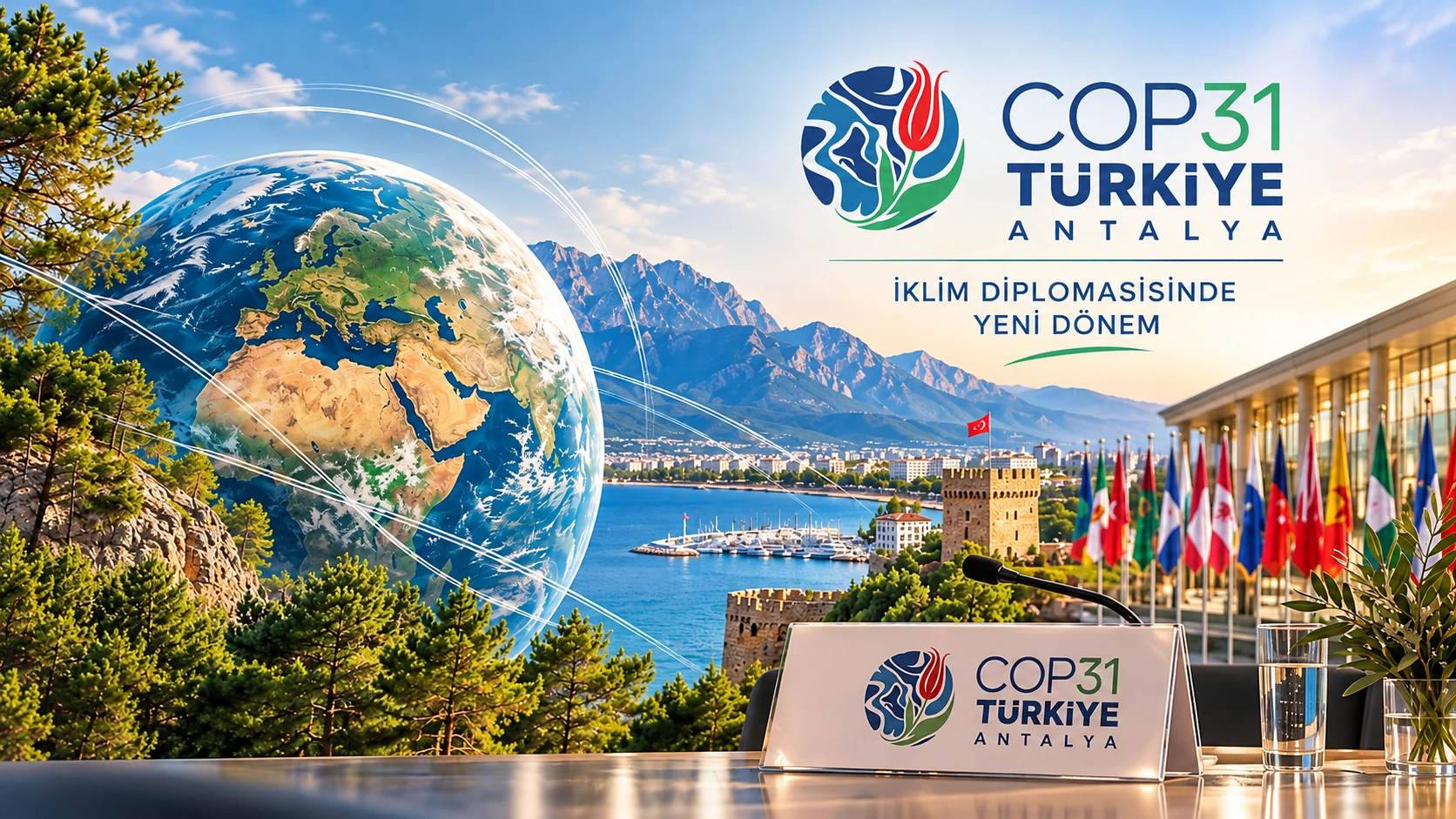
COP31, scheduled to take place in Antalya from 9 to 20 November 2026, will bring together heads of state and government, ministers, diplomats, scientists, international organisations, private-sector representatives, and civil society organisations from around the world.
The World Leaders Climate Action Summit, scheduled for 11–12 November, will be one of the conference's most important high-level political gatherings.
The COP31 programme has been structured around thematic days addressing different dimensions of climate change. Food, agriculture and health; energy and transport; zero waste and the circular economy; resilient cities; climate finance; children and young people; science, industry and technology; and oceans, seas, nature and land use will all feature on the conference agenda.
The thematic focus on oceans, seas, nature and land use on 17 November will bring renewed attention to the role of natural ecosystems in tackling climate change. Forest conservation and restoration, biodiversity, ecosystem services, and the climate resilience of coastal areas will be considered within this framework.
Türkiye's announced priorities include zero waste, the circular economy, the clean energy transition, green industrialisation, food security, sustainable agriculture, climate-resilient cities, the protection of marine and terrestrial ecosystems, and the development of climate finance.
What these priorities have in common is that they demonstrate why climate change cannot be addressed solely through emissions reduction. Climate policies need to be considered in an integrated manner across all sectors, from water resources and agriculture to forestry and urban planning.
Forests and Water Resources: Strategic Priorities for Climate Diplomacy
Hosting COP31 in Türkiye presents an important opportunity, particularly in relation to forests, water resources, and Mediterranean ecosystems.
Forest ecosystems perform critical functions not only in capturing and storing atmospheric carbon, but also in regulating the water cycle, protecting soil, maintaining biodiversity, and supporting climate change adaptation.
At the same time, the impacts of climate change on forest ecosystems are becoming increasingly evident. Longer periods of drought, rising temperatures, and extreme weather events increase wildfire risk while also affecting the carbon sequestration capacity and overall health of forests.
In this context, addressing issues such as wildfire prevention, the development of early warning systems, the establishment of climate-resilient forests, and ecosystem restoration through international cooperation is of great importance.
Similarly, the protection and sustainable use of water resources should be among the key priorities of climate diplomacy. Water scarcity, particularly across the Mediterranean and Middle East, has direct implications for agricultural production, rural development, and social well-being.
Sharing Türkiye's forestry experience, the technologies it has developed to combat wildfires, its watershed management practices, and its nature-based solutions on international platforms could make a significant contribution to COP31's implementation-oriented approach.
What Will Remain After Antalya?
The success of major international conferences cannot be measured solely by the number of participants, the meetings held, or the media visibility they generate. What truly matters is which partnerships are established, which financing mechanisms are developed, and which concrete projects are implemented in the aftermath.
COP31 should be assessed in the same way from Türkiye's perspective.
Bringing representatives from countries around the world together in Antalya will increase Türkiye's visibility in international climate policy. However, turning this visibility into a lasting diplomatic achievement will depend on the partnerships and cooperation initiatives that continue beyond the conference.
Transforming Türkiye's regional experience into international projects, strengthening its access to climate finance, advancing technology and knowledge-sharing, and implementing joint initiatives with countries across the Mediterranean basin could become important outcomes of this process.
COP31 will also provide universities, research institutions, public authorities, local governments, and the private sector in Türkiye with opportunities to engage in international networks and develop new partnerships.
Climate change may be a problem that recognises no borders, but finding solutions requires bringing together the knowledge, experience, and institutional capacities of different countries.
In this respect, COP31 in Antalya will represent an important step in Türkiye's efforts to become not merely a country that follows the global climate agenda, but one that actively contributes to shaping and implementing it.
Perhaps the most important question of this conference will be: To what extent will the world be able to turn its promises on tackling climate change into action?
Because the issue is no longer which COP is being held or how many countries gather around the same table. The real question is how effectively the decisions made at that table will translate into tangible outcomes in forests, fields, cities, river basins, and people's daily lives.
The negotiating table to be established in Antalya will seek answers to this question. For Türkiye, this process offers an opportunity that goes beyond hosting an international conference: the opportunity to demonstrate lasting cooperation and implementation capacity in international climate diplomacy.
Antalya için çok faydalı bir etkinlik olacağını düşünüyorum. Yeşil alan girişleri için kayıt yaptırmalı mıyız ? Yazınızı çok beğendim, paylaşım için teşekkür ederim.
Kaleminize sağlık! COP31 gibi küresel ve hayati önem taşıyan bir zirveyi bu kadar berrak bir vizyonla ele almanız gerçekten çok kıymetli. İklim krizinin artık sadece çevresel değil, ekonomik ve sosyal bir geleceğin inşası olduğunu çok net vurgulamışsınız. Sadece sorunları sıralamakla kalmayıp umut aşılayan ve somut adımların altını çizen bu satırlar için teşekkür ederim. Yolunuz, kaleminiz daim olsun!"